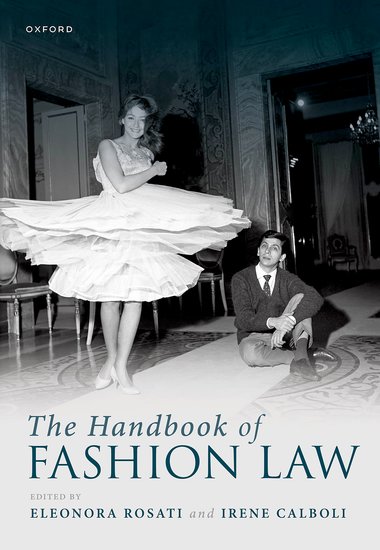

Fashion and law – are two fields that may seem worlds apart at first glance, yet they intersect in fascinating ways. The legal framework plays a crucial role in shaping this dynamic industry, from intellectual property protection and contracts with designers and brands to sustainability and ethical issues. Today, we have the pleasure of speaking with Eleonora Rosati,one of the editors of The Handbook of Fashion Law, which was published by the renowned Oxford University Press on 14 March 2025. This groundbreaking publication comprehensively analyses legal matters related to the global fashion industry, combining expert insights with practical perspectives. Our guest will share with us the biggest legal challenges facing the fashion sector, the process of creating this exceptional book, and her thoughts on the future of fashion law.
FL: What inspired you to compile the Handbook of Fashion Law and which gaps in existing literature does this publication address?
I would like to start by noting that fashion law is an emerging area of study, practice, and research. Let me point out at the outset that, formally, there is no such thing as fashion law. What we call “fashion law” is indeed the different areas of the law that are of relevance to the fashion sector. For them to be applied meaningfully and correctly, it is necessary to take into account the specificities of this business sector. Prof. Calboli and I felt the need to provide a handbook that would serve as a guide for a global readership. When we looked at the resources available at the time, we saw that there were some resources which were very good but a bit dated, and resources that were not really targeting lawyers working with fashion businesses, but rather creatives and indeed readers without necessarily a legal background. So, our goal was to give shape to the emerging area of fashion law, to map the most important legal issues, and do so with a perspective that would be both international, comparative, if not global, and by indeed having in mind also a reader that is an expert in the law.
FL: Could you briefly outline the key areas of fashion law covered in the handbook?
Well, there are plenty of them. Of course, the initial part is about providing an overview of the infrastructure of the fashion and luxury industries. We looked to intellectual property but went beyond that. We included an international perspective, cross-border enforcement issues, the role, responsibility and liabilities of intermediaries, and then questions relating to intellectual property, sustainability in the circular economy, the treatment of fast fashion, the risk of appropriation and misappropriation of cultural heritage, and then, of course, the relationship between fashion and free speech from the perspective of offensive trademarks. Then we looked into more specifically the IP dimension, reviewing relevant issues under copyright, design rights / design patents, trademarks, as well as geographical indications, patents, plant varieties, and trade secrets. Then we considered various aspects relating to contracts, competition law and regulation, including merchandising and licensing of fashion assets, collaborations within the luxury fashion sector, contracts of fashion workers (like influencers), and then the application of competition law, regulatory compliance, advertising rules, greenwashing, consumer protection, and also corporate and tax aspects. In the final part, we looked into the relationship between tech and fashion, starting with e- commerce, 3D printing, the use of predictive artificial intelligence, generative AI from a moral rights perspective, then the metaverse and Web3 more in general, the relationship between fashion and gaming, and then the treatment of wearables from a data protection perspective.
FL: How do you envision the future of fashion law, particularly regarding sustainability and intellectual property?
Well, the future of fashion law is, I think, in development. There will be, of course, new and emerging issues in a rather limited time frame because this is a fast-paced sector and so are the issues of relevance to it. In so far as sustainability and IP are concerned, I think that case law will begin emerging more clearly regarding the treatment of areas such as exhaustion / first sale doctrine, but also whether we are speaking of prima facie infringements in the first place, the treatment of greenwashing from an advertising and regulatory perspective, etc. I think that the future will be one of increasing clarity, but possibly also increasing regulation in this sector.
FL: Who in your view will benefit most from this handbook? And how might it influence both legal professionals and those within the fashion industry?
We believe that this book will be primarily of interest to those with a legal background and who wish to know about fashion law-related issues from a broader perspective than simply a national or regional perspective. We’ve included different legal layers: international, regional, national, but also comparative perspectives. I believe that the book will be of interest to those working in fashion and also those interested in cross-border aspects relating to the treatment of fashion assets broadly intended.
FL: What were the most significant challenges you encountered while compiling this handbook?
We are grateful that so many authors accepted our invitation to contribute to the handbook. We have indeed over 40 chapters, and the authors range from scholars to private practice lawyers to in-house practitioners and members of regulatory agencies and international organizations. I would not say that we faced any particular – or at least insurmountable! – challenges. Of course, as any area of the law that is fast-paced, a key aspect was to provide a handbook that would be indeed current and valuable insofar as the current – and forthcoming – issues facing the fashion sector are concerned.
FL: How do you manage the complexity of balancing creativity and legal constraints within fashion law?
That is an issue that affects many creative sectors. It is about striking a fair balance between protection and free competition. In the book, we provide plenty of examples from different jurisdictions. I would say that here it is always an approximation that is done. It is a matter of considering relevant circumstances and making sure that the needs and, indeed, the rights of different stakeholders are respected.
FL: Could you highlight some interesting case studies or examples included in the handbook?
As I mentioned when I was reviewing the table of contents, we have examples ranging from indeed the treatment of luxury trademarks, well-known trademarks to wearables, gaming and the artificial intelligence. I believe that there is something for everyone in the handbook, depending on the area of the law that one is interested in. There is plenty of case law that is reviewed, plenty of case studies, and we are proud that the book indeed covers this important dimension as well.
FL: What advice would you offer students or professionals interested in specializing in fashion law?
Well, I think that the most important one is not to have a tunnel vision. So, if one wants to become an IP lawyer specializing in fashion, you cannot think that you should be knowing only about fashion-related cases. You must know about IP and see how that would apply to the fashion sector. What I always tell the students who approach me and would like to work in this sector is to make sure that you do the groundwork first, that you are a good IP lawyer and then look into specific fashion cases. Think about how a case that doesn’t relate to fashion would play out in a fashion context and so on. That is the only way to be a successful and indeed well-prepared IP lawyer working in fashion.
FL: Thank you very much for such an insightful conversation and for sharing your expertise on fashion law with us. The Handbook of Fashion Law is undoubtedly a must-read for lawyers, designers, entrepreneurs, and anyone looking to better understand the complex world of legal regulations in the fashion industry. We wish you continued success and hope that the book receives well-deserved recognition both in the legal community and among fashion enthusiasts!